Middle East · Visual Explainer
2026
US/Israel vs
direct Iran War
How a surprise U.S.–Israeli campaign became a regional confrontation—reopening the Lebanon front and turning the Strait of Hormuz into the center of a new economic crisis.
Began February 28Updated through September 4, 2026
IranIsraelLebanonStrait of Hormuz
The conflict in one minute
From leadership strikes to a fight over the world's oil chokepoint.
Shock
On February 28, the United States and Israel launched nearly 900 strikes in 12 hours. The opening wave killed Supreme Leader Ali Khamenei and many senior officials.
Spread
Iran answered with hundreds of missiles and thousands of drones, widening the conflict to Israel, U.S. facilities, Gulf cities, energy infrastructure, and commercial shipping.
Brinkmanship
An April ceasefire reduced direct attacks, but the war shifted to Hormuz. A June memorandum failed when the parties disputed its safe-passage terms.
The arc of the war
Six months that changed the region.
From Operation Epic Fury to the renewed exchange of fire in late August.
Operation Epic Fury begins
Joint strikes hit air defenses, missiles, military infrastructure, nuclear-related facilities, and Iran's command structure.
Iran widens the battlefield
Missiles and drones target Israel, U.S. facilities, Gulf states, oil infrastructure, and shipping. Hezbollah reenters the war.
A fragile ceasefire
Pakistan brokers a pause, but disagreement over the Strait of Hormuz blocks a durable settlement.
A memorandum, not peace
The parties agree on Lebanon, sanctions, force reductions, reconstruction, and 60 days of safe passage.
The truce breaks at sea
The IRGC strikes three ships on a U.S.-recommended route. Trump declares the truce over.
Hormuz remains the pressure point
U.S. forces clear mines and strike Larak Island over alleged preparations to deploy more. Iran retaliates.
Opening campaign
Operation Epic Fury
The American name for the joint campaign—built around speed, surprise, and an attempt to disable Iran's command structure before it dispersed.
Nearly 900 coordinated strikes
The timing was reportedly chosen partly to reach Khamenei before he went into hiding. Targets included air defenses, missiles, military and nuclear-related infrastructure, and senior leaders.
Leadership continuity
Iran prevented a vacuum. Ali Larijani initially coordinated the state; Mojtaba Khamenei became supreme leader.
Horizontal escalation
Iran widened the war geographically and economically to make it too costly to sustain.
IranOmanCommercial route →
The ceasefire fault line
One sentence.
Two interpretations.
The June memorandum promised safe passage for 60 days, but did not resolve who controlled the routes.
Safe passage meant unrestricted passage.
Washington believed Iran had to protect commercial vessels in international lanes. It treated the July attacks as a breach.
Passage still followed Iranian protocols.
Tehran read the text as recognition of its administrative role and guaranteed passage only on approved routes.
Why tensions ran so deep
The conflict had a long fuse.
Decades of grievances converged with failed diplomacy, proxy warfare, nuclear uncertainty, and a shifting military balance.
The coup
U.S. involvement in Mosaddegh's overthrow became a lasting Iranian grievance.
Revolution & hostages
The revolution ended the alliance; the hostage crisis hardened hostility.
Nuclear secrecy
Iran's nuclear program intensified proliferation fears and sanctions.
JCPOA withdrawal
The U.S. exit weakened diplomatic containment and restarted escalation.
A changing balance
Israel degraded Hezbollah and Iranian defenses; the 12-Day War damaged military and nuclear sites.
Diplomacy collapses
Failed talks, protests, a violent crackdown, and a U.S. buildup preceded the attack.
The wider network
Three allies. Three very different roles.
Iran’s regional network did not enter the war as one unified force. Hezbollah reopened a major front, the Houthis expanded pressure from Yemen, while Hamas mattered chiefly as part of the conflict’s background and the earlier weakening of Iran’s regional position.
Hezbollah in Lebanon
After Israeli strikes on Hezbollah infrastructure, the group launched missiles and drones at Israel on March 2. Israel expanded attacks into Beirut, began a limited ground invasion on March 17, and announced plans to occupy southern Lebanon to the Litani River.
- More than 1.1 million people displaced by late March
- A suspected Hezbollah drone struck a British-used base in Cyprus
- Repeated ceasefires failed to produce a lasting end to hostilities
Houthis in Yemen
Iranian officials suggested the Houthis could threaten the Bab el-Mandeb Strait, adding pressure on Red Sea shipping while Hormuz was already disrupted. On March 28, the Iran-aligned movement launched missiles and drones toward Israel.
- Opened another geographic front in the regional conflict
- Raised the possibility of simultaneous pressure on two shipping chokepoints
- Risked ending the Houthis’ earlier ceasefire with the United States
Hamas in Gaza
The supplied account does not describe Hamas opening a direct new front in the 2026 war. Its importance is contextual: the earlier Israel–Hamas war helped Israel degrade Iran’s wider “Axis of Resistance” and changed the balance before the attack on Iran.
- Not presented as a principal 2026 combatant in this account
- The Gaza war drew Iran’s allied network into earlier confrontation
- Losses across that network contributed to Iran’s weakened posture
Important distinction
“Iran-backed” does not mean every organization took identical orders or played the same role. Their interests, capabilities, and willingness to confront the United States differed.
Beyond the battlefield
A regional war with global consequences.
Hormuz traffic
Attacks, selective passage, blockades, tolls, and mines constricted the oil chokepoint.
Oil price shock
Prices surged in March, causing shortages and rationing in parts of Asia.
Displaced in Lebanon
Renewed Israel–Hezbollah fighting displaced more than one-sixth of the population.
Regional aviation
Flights were severely disrupted; drone damage temporarily halted Dubai International Airport.
Key terms
Two names to know.
Pickaxe Mountain
A deeply buried complex beside Natanz. Iran describes it as a centrifuge-production facility; analysts have raised concerns about possible enrichment or storage uses. Its depth makes conventional attack difficult.
Popular Mobilization Forces
An Iraqi state-sponsored umbrella of armed groups mobilized in 2014 against ISIS and later incorporated into Iraq's security establishment. Some powerful factions have close ties to Iran.
B
Explore the original article
Britannica
A section-by-section route into Encyclopaedia Britannica’s reporting. Each card begins with the opening sentence from that part of the article.
01
Conflict
Read at Britannica ↗Conflict
Midmorning on February 28, U.S. and Israeli forces began conducting joint strikes on Iran, numbering nearly 900 in just the first 12 hours of what the United States dubbed Operation Epic Fury.
Open section ↗CeasefireOn April 7–8 Trump announced on social media that he had agreed to a two-week ceasefire brokered by Pakistan.
Open section ↗Conflict in LebanonThe conflict also saw the resumption of hostilities between Israel and Iran’s close ally Hezbollah in Lebanon, which had been observing a fragile ceasefire since 2024.
Open section ↗Crack in the ceasefireTensions ebbed and flowed throughout the duration of the ceasefire reached by the United States and Iran, although it largely held.
Open section ↗Memorandum of understandingOn June 14 Shehbaz Sharif, the prime minister of Pakistan and a key mediator, announced that the United States and Iran had finalized a memorandum of understanding.
Open section ↗Continued fighting over the Strait of HormuzThe disagreement between the United States and Iran came to a head on July 6 and 7, when the IRGC struck three ships as they were passing through the strait along the Omani coast, a route that was recommended by the United States.
Open section ↗02
Reactions and impact
Read at Britannica ↗Initial reactions
The outbreak of conflict between three widely impactful countries led to a burst of reactions, ranging from anticipation to condemnation to confrontation.
Open section ↗Global economic impact and the disruption in the Strait of HormuzThe war had immediate impacts on global travel and trade.
Open section ↗Headings and opening sentences from “2026 Iran war,” Encyclopaedia Britannica, updated September 4, 2026.
All nine answers
The essential questions.
Select a question to reveal its answer.
01What is Pickaxe Mountain?
A deeply buried underground complex south of Natanz. Iran says it supports centrifuge production; analysts have considered possible enrichment or protected-storage roles.
02What is the Popular Mobilization Forces (PMF) in Iraq?
A state-sponsored umbrella of Iraqi armed groups created during the fight against ISIS. Some major factions maintain close relations with Iran.
03Why did Trump declare the ceasefire over in July 2026?
The IRGC struck three ships on July 6–7 along a U.S.-recommended route. Washington viewed this as violating June's safe-passage commitment.
04Why did Iran attack ships after the June ceasefire?
Iran said ships still had to follow its routes and protocols; the United States believed the agreement guaranteed unrestricted transit.
05What was Operation Epic Fury?
The U.S. name for the joint campaign launched February 28. Nearly 900 opening strikes targeted air defenses, missiles, infrastructure, and leaders.
06What caused U.S.–Iran tensions before the conflict?
The 1953 coup, 1979 revolution, nuclear program, missiles, regional armed allies, sanctions, JCPOA collapse, fighting with Israel, and failed diplomacy.
07How did the United States and Israel begin the operation?
They launched surprise midmorning strikes. The timing was partly chosen to reach Khamenei before he hid; he was killed in the first wave.
08What was Iran's response to the February strikes?
Iran replaced killed leaders and launched hundreds of missiles and thousands of drones across Israel and the Gulf region.
09What was the global impact?
Thousands were killed, millions displaced, Hormuz traffic collapsed, oil prices surged, shortages hit Asia, and regional aviation was disrupted.
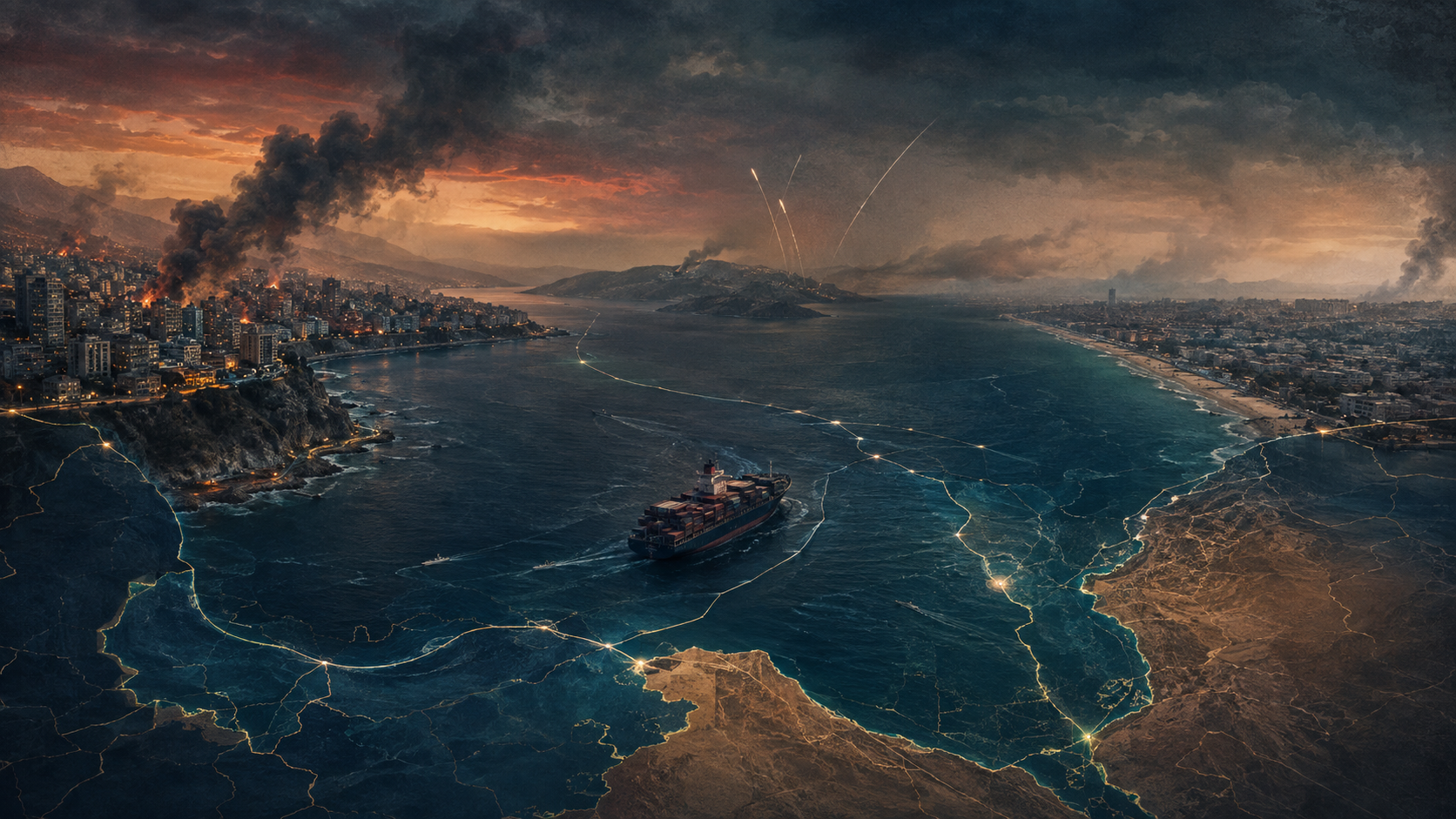
About this explainerBased on the Encyclopaedia Britannica excerpt supplied for this project, updated September 4, 2026. Pickaxe Mountain and PMF definitions add background context. The map is schematic.